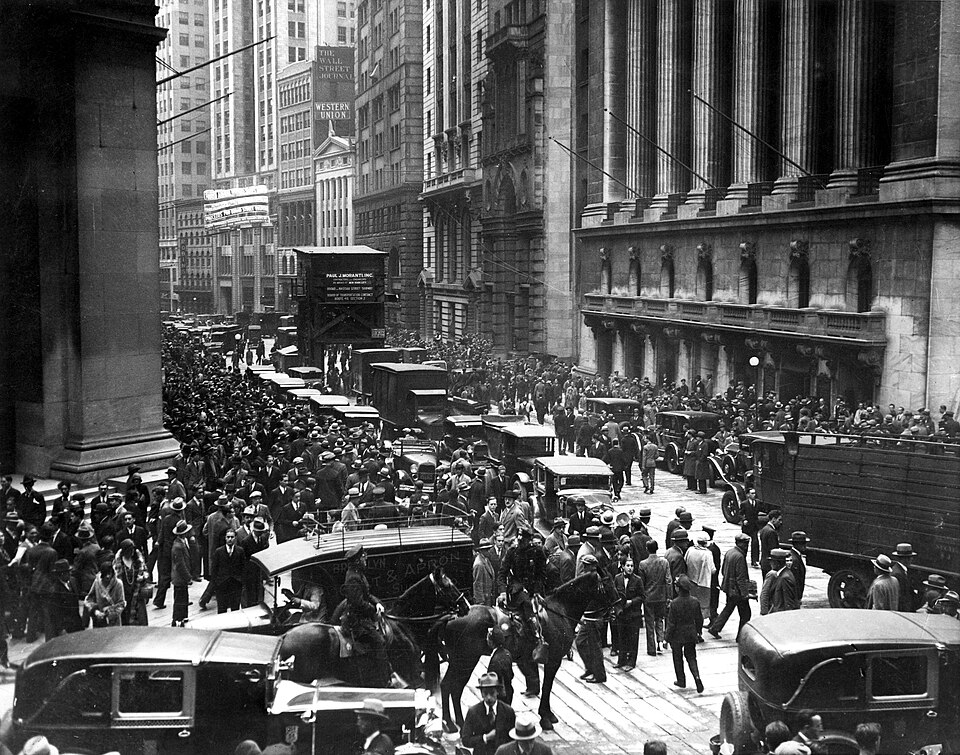
While we don’t necessarily expect economic history to repeat itself, it can help to look for some possible rhymes.
Jacob Weisberg starts his New York Review of Books review of Andrew Ross Sorkin’s new book 1929: Inside the Greatest Crash in Wall Street History—and How It Shattered a Nation by describing some common beliefs about the AI boom:
The current boom in artificial intelligence stands apart for its lack of denial. The notion that we are in the frothy, hype-driven phase of technological speculation has become conventional wisdom. Venture capitalists and technologists openly acknowledge that valuations are inflated, expectations are overblown, and vast sums of capital are chasing both promise and illusion. Rather than contesting the bubble’s existence, they embrace it as not only inevitable but perhaps even essential to the breakthroughs ahead. This marks a subtle but significant evolution: where previous bubbles were about believing in the impossible, the current one seems to involve believing in the bubble itself.
Weisberg describes economists Carlota Perez’s supposition that bubbles can result in investment that overreaches but can result in creating infrastructure that ends up as the foundation for new technologies. A major example being overbuilding of railroad lines which ended up making the industrial revolution possible. Another example is the overbuilding of fiber infrastructure which caused the failure of many companies, but paved the way for the growth of the internet.
You can imagine that the datacenter boom might be a new case of this phenomenon, although Weisberg fears that chip obsolescence might make their capabilities less general purpose and more likely to lose value.
After spending time on the Sorkin 1929 book, John Kenneth Galbraith’s The Great Crash, 1929, and Liaquat Ahamed’s 2009 book Lords of Finance, Weisberg brings up features of the AI boom that might make it hard to temper or moderate with modern tools: private credit markets, off-balance-sheet vehicles, and co-finance arrangements. These financing mechanisms that move risk outside the regulated banking system, hiding the true scale and interconnectedness of AI borrowing from regulators in ways that echo the opaque mortgage structures that triggered the 2008 collapse.
In particular, the co-financing arrangements where AI software and hardware companies invest in each other in deals often confuse attempts to assign value and end up injecting heightened demand into an already fevered investing atmosphere.
It is good that most of the players realize that the AI boom has all of the calling cards of a speculative bubble and that bubbles can have redeeming characteristics. However, as Weisberg notes, we should be looking at crashes like 1929 and 2008 to understand how we can cushion our landing.